Burst from your political bubble.
A concept news app that pulls U.S. political coverage from vetted sources, gives local politics its own space, and nudges readers toward the other side of every story. I took it from user research all the way through a Figma prototype.

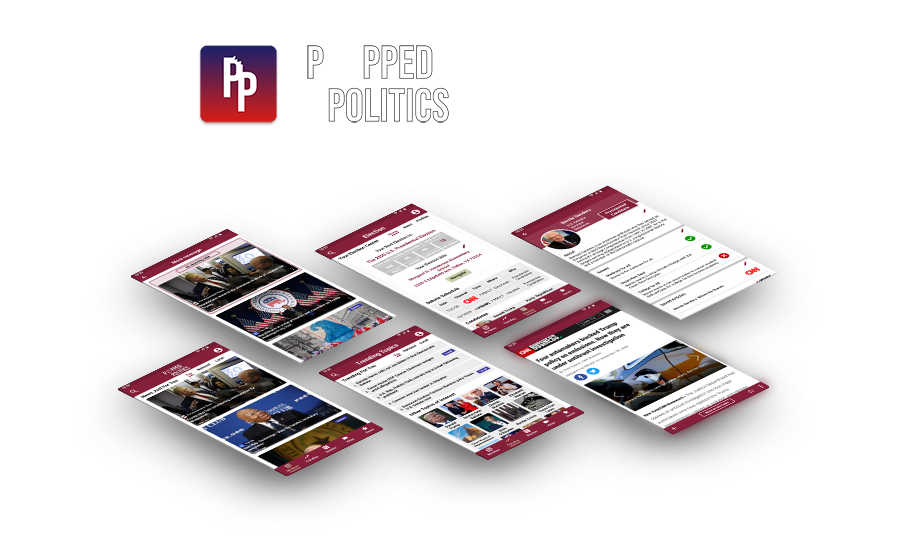
A friend of mine, a senior product analyst at a mobile app company, and I set out to design a political news app from scratch. Over about two and a half weeks we ran market and competitor analysis and user interviews, and used the pain points that surfaced as the foundation for every design decision.
Goals
Responsibilities
What readers kept telling us.
{{ q }}
Coming at the problem from three directions.
We talked to readers, sized up the market, and took apart the products that already existed, then used what overlapped as the foundation for the design.
Four prospective users, politically moderate to middle-left, mid-20s to early-30s. What we heard, again and again:
Public data pointed clearly at a young, mobile-first, increasingly engaged audience.
{{ s.label }}
Pulling apart existing aggregators showed how the model works and where it wins.
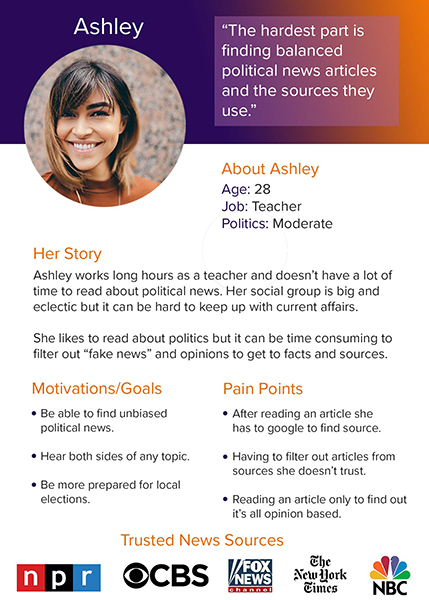
Cut through the noise, cover local politics, prepare people for elections, and make it easy to read across the spectrum, all in a product that feels familiar but does something competitors don't.
To strip out the most biased media in a way that was transparent and data-driven, we built the source list on Ad Fontes Media's Media Bias Chart. It justified which outlets to include or leave out while still letting readers shape their own experience within a trusted set. We explain the approach up front during onboarding.
Working it out on paper first.
Pen and paper let us iterate fast on each section and test how it addressed the pain points. Most of the structure built on Google News's model, with features of our own layered in.
Some ideas didn't make it: a candidate-merchandise store, quizzing users on what they'd read, in-app voter registration. They were either too complicated or came way too early in the process, and cutting them kept the scope realistic.
Three ideas the design had to land.
Beyond trusted sources, the mockups focus on local political news, political well-roundedness, and tying everyday news to elections. Built in Figma, with logos and an app icon made in Illustrator.
{{ f.title }}
{{ f.desc }}
The full prototype.
What it taught me.
This project drove home how much research should lead design — and that no matter how attached you are to an idea, you sometimes need to set the ego aside and ask whether you're actually solving the problem. Early on I'd baked in revenue features like a points system for buying candidate merch, and a voter-registration flow. Both were too complex, or arrived far too early in the process, and cutting them made the design stronger.
It also left me with a good question. We aimed at 18–44, but research showed people over 50 were far more likely to share fake news. Would an older audience benefit more? Would they even want this? That's where I'd take the research next.
Back to all work